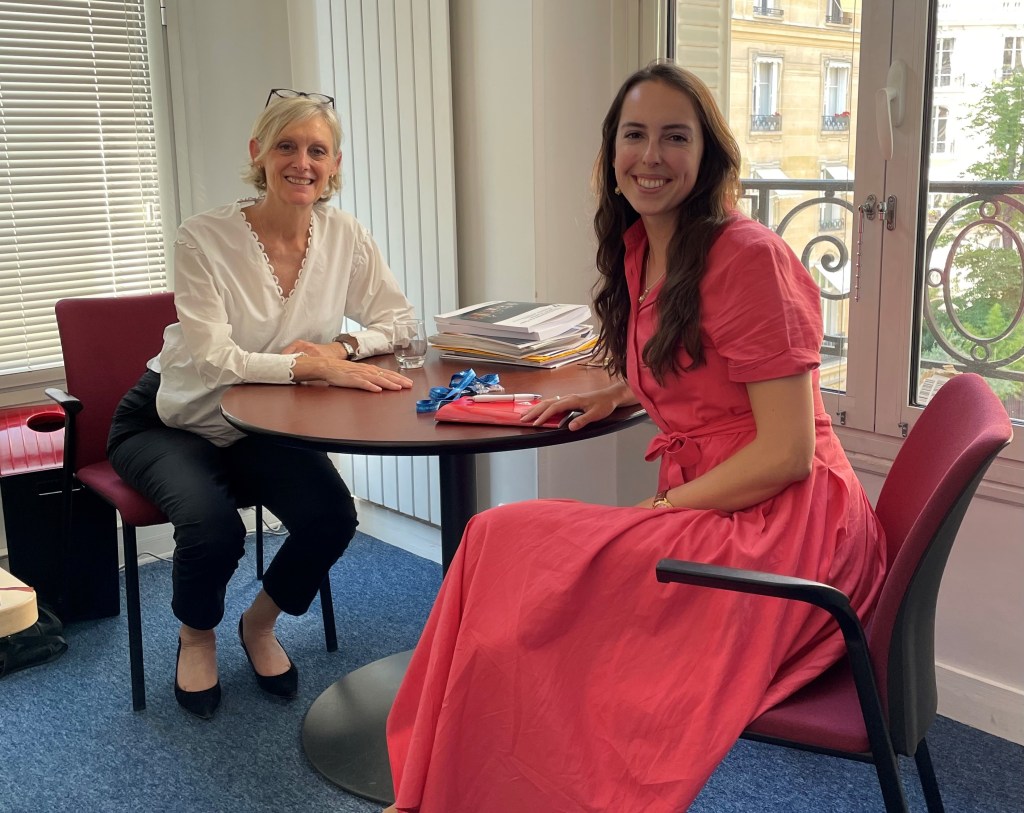
In the dynamic realm of social policy, Monika Queisser, the Head of the Social Policy Division at the OECD, has made her mark by tackling pressing global challenges. With almost three decades of experience at the OECD, Monika Queisser has supervised and coordinated work on critical areas such as social protection, affordable housing, pensions, family policies, and LGBTI+ rights.
In this interview, she shares insights on emerging social issues, the strategic focus of the Social Policy Division, the transformative impact of OECD recommendations on countries’ social policies and gives career advice. Her passion for social policy and her commitment to making a difference shine through as she discusses the challenges and rewards of her role at the OECD.
Valeria Silva Gomez: The OECD’s research and advice often addresses pressing issues such as climate change, AI, or migration challenges. What do you think are the emerging social issues that policy makers should prepare for today?
Monika Queisser: There are traditional issues of trends that we knew were coming a long time ago. Population aging is a mega trend we should be prepared for, but we are not really.

One of the big issues there is long-term care. Care workers are badly paid, not well respected, or are stuck in dead-end careers. It is essential to think about the future of care in a more structured and forward-looking way. In our forthcoming report “Beyond Applause?” (Annotation VSG: Launched today!), we urge countries to not only applaud on their balconies, but to put their money where their mouth is.
“The world of social policy is full of new challenges. It never gets boring.“
The other trend is digitalization and AI. How is the rapid technological development changing our labor markets? Which skills do workers of the future need? We need to prepare people to change their careers multiple times over their lives. Even harder: How do we educate our young people when no one knows what the jobs of the future are?
We are also thinking about the positive side of digitalization in social policy: How can you use new technologies to better deliver public services? But then there’s also new risks of stigma. Or the risk of hacking. Digitalization has both sides. – The world of social policy is full of new challenges, and it never gets boring.
VSG: What about climate change?
MQ: The social effects of climate change will cause a lot of disruption, whether it’s closing down of coal mines in Canada or the controversial heating law in Germany. One question remains unsolved: Who’s going to pay for it and how? What new taxes could be levied on whom? Even with massive government subsidies, it’s still too expensive for many households. We are thinking about: What does that mean for inequality? And how do you get people on board to make those sacrifices?
We will have to find multiple resources for multiple challenges ahead of us. Urgently.
VSG: Given those challenges, how do you, as the head of the social policy division, decide on your division’s strategic focus?
MQ: Our bosses are the member countries, we are their Secretariat. The OECD makes proposals which we present to our committees and working parties to vote. The committees and working parties are made up of people from the member countries’ ministries of employment, social affairs, migration, education, environment, etc. They decide bi-annually on our programme of work and budget, which includes collecting data, maintaining databases and infrastructure which we then use for our policy analysis and recommendations.
For social policy, there are many requests and important topics to cover but we don’t have much fixed funding, so our voluntary contributions by the member countries have become more important. We spend quite a bit of time fundraising, mostly from our members and other international organizations, such as the European Commission.
VSG: I see. So, if you identify an emerging issue you want to focus on, it either must be in that bi-annual budget or you need to seek funding for your proposal?
“You get good fundraising skills here.”
MQ: Exactly. We propose ideas, for example, a country review on gender. And then we ask, “Who wants to buy in?” And then they get in touch with us.
VSG: Is that sometimes frustrating if your proposals don’t align with what countries want?
MQ: Sometimes we have great ideas and proposals, and nobody wants them. But so is life. As the head of social policy, together with the team leaders, we have to raise quite a bit of money every year in order to make sure we can work on the most pressing social issues.
VSG: I wasn’t aware that this job has such a fundraising component.
MQ: It’s not as hard as fundraising for a startup because there’s lots of natural interaction with the member countries and when the proposal is good, we usually succeed in getting countries on board. But we are not a consultancy, we remain within the agreed framework. But yes, you get good fundraising skills here [Queisser chuckles].
VSG: What motivated you to work here at the OECD for such a long time?
“We go in depth, but we’re also connected to real policy issues.“
MQ: I got here in 1997. I was at the WorldBank before, and I think I was motivated to come to the OECD for a couple of reasons. I liked the work at the WorldBank because they gave young people an enormous amount of responsibility. But after having worked with many countries around the world I was keen to return to work with OECD countries, including my own country, Germany, and applying my experience and policy advice to a set of different contexts. I was also really attracted to the OECD’s way of developing data and policy analysis.
VSG: You were based in Washington, D.C., back then.
MQ: In D.C., but traveling all the time. I have to say I also missed being in Europe and started looking around for options there. I had a contact at the OECD who told me someone in his team was retiring, so I applied for the job – and the rest is history!
I love international organizations. I love working in multiple languages. It’s just really fulfilling to work with so many different people from different places.
I also love the policy advice and the research part. We go in depth, but we’re also connected to real policy issues. It’s more academic than, let’s say, a consultancy firm because you have more time and all your colleagues are kind of slightly geeky economist [laughing]. – People who love digging, digging into numbers, into facts, and really going deep. I quite enjoy that.
And that paired with a possibility to consult with governments. I think it never gets boring because social policy is so varied. Our latest project is social housing research. People are spending on average at least a third of their disposable income on housing. We knew we had to work on this. Due to the housing crisis during COVID-19, the financial crisis, and the inflation, we now convinced the member countries to work on social housing issues.
VSG: What brought you to social policy?
“Social Policy is cultural, political, historical!”
MQ: The number one thing that I like about it is that it’s very close to people. It’s cultural, political, and historical. You have very different countries around the world. Take New Zealand and Australia, for example. They don’t have social insurance systems, they have means-tested social benefits, and the rest is organized quite privately. Contrast that with the continental European countries, which historically have huge social insurance systems. Pensions is a topic that makes governments fall. You would think that health would be much more important because it affects everyone constantly. But it’s pensions that make people really upset if you suggest they have to work longer, or you cut their benefits. That fascinated me.
For my master’s diploma, I went to Southeast Asia and started comparing pension systems in Southeast Asia. Then I moved to Latin America and I wrote my PhD about pension systems in Chile. Social policy served me well because international organizations were looking for this specialization at the time after the fall of the Berlin Wall when they suddenly found themselves faced with all these gigantic social insurance institutions they were not used to.
VSG: You specialized in pensions so early! Here’s a question that I ask myself a lot: Should young people who want to work in international organizations aim for a broad skill set (like economics and public policy, or economics and law), or should they rather try to get a topical expertise early on that can be useful for international institutions?
MQ: My personal advice is if you have something that you’re particularly interested in, I would 100 % represent specialization. Especially, if it’s something that isn’t super popular, and especially as a young woman! I stumbled into it, but I discovered that there were few people in the world working on pensions. In my case, there were practically no women. So if you have some expertise, people will listen to you, even if you’re a young woman. And I found that incredibly helpful for the management of my career.
VSG: What’s your advice for young policy students who want to work at the OECD or another international organization? What skills do you think are the most important here?
MQ: First, international organizations are very different. Ask yourself some general questions: Where do you want to live? How political and/or project-oriented should your work be? Are you more interested in middle-, high-, or low-income countries?
In terms of skills, it’s become very quantitative and data oriented. In the social policy division, we place a lot of importance in developing data and statistical evidence to counter the arguments of our economics colleagues at the OECD “in their language”. That changes the profile of the people that we hire. Even for interns, you have to be quantitative. Take that econometrics class if you are interested in it! (Annotation VSG: Don’t worry, there are other directorates at the OECD and other international organizations that are less quant heavy.)
VSG: Can you share an anecdote where you witnessed firsthand the impact of OECD recommendations on countries’ social policy?
MQ: I have two good examples. Long time ago when Germany was contemplating a pension reform, they had plans to build a model only based on private pensions (Riester pensions). I thought: We already have a well-functioning occupational pension system, and there’s good things there. Be careful not to forget about that, because collective solutions tend to be cheaper for the people than having private solutions. I went to the Chancellery and started heated discussions. And suddenly, – I remember I went to another conference – people were saying: “Nobody understands what happened, but suddenly the support for the collective pension solutions came back on the table.” My argument had made an impact. It was very gratifying.
“Huge impact on young people’s lives.”
Another thing was when we were working on the Finland Youth review. In order for people to have a better school-to-work-transition, we presented our report and recommended increasing the age of compulsory education from 16 to 18. And they did that. Huge impact on young people’s lives.
Some of our reports are also very influential for the public debate. Take for example, our work on inequality (“Growing Unequal“, “Divided We Stand: Why Inequality Keeps Rising“, “In It Together: Why Less Inequality Benefits All“). We’ve developed them here in the Social Policy Division and they really hit at a time when the world was ripe for it: during the Occupy Wall Street movement and just after the financial crisis. Since the OECD was known to be a conservative organization, when the OECD came out with data and strong recommendations about how dangerous the increasing inequality is, it had an impact. Good solutions, based on extensive data, at right time can have a real impact!
VSG:. Thank you, Monika, for sharing your valuable insights with me!
MQ: You’re welcome!

For those econ & social policy geeks amongst you: See a concise overview of recent OECD social policy related reports and datasets here.
 Valeria Silva Gomez, 2023
Comments