When I open my laptop in the morning, I have 27 browser tabs open. Several legal texts, constitutions, or reports by NGOs on Greece, Colombia, or Italy. One tab is always a translation service. I am researching which laws are in place in OECD member countries that guarantee LGBTI+ people the same rights as everyone else. Within a few days, I became a semi-expert in interpreting foreign laws and constitutional court cases.
My work at the OECD has been different from what I expected – in a good way. Here are my three take-aways from my first two weeks.
Jump into cold water
Legal research for a numbers nerd like me? At first, I found it quite challenging to navigate the endless paragraph and cross-links. I’ve always thought I find legal details boring. Turns out, I like it. After a while, when you bother to think through the complicated legal system of a few countries, you get the gist. And suddenly, you find yourself googling legal questions outside of work as well, out of curiosity. My takeaway: Try out new things often. Do that R course, sign up for that French lesson*, or read that odd book on Roman history, your uncle gave you for your birthday three years ago. But watch out, you might like it.
Not for the faint-hearted
OECD is a multilateral organization, 38 member countries, residing in a chateau in Paris. It analyses data, writes reports, and hosts conferences for policy makers. Doesn’t sound like it’s too close to “the people.” Yet, what surprised me was how human-centered the work at the social policy division is. What I have seen in my first two weeks here is a lot of people that deeply care about fighting the root causes of homelessness, making pension systems work for the elderly in an aging world, bridging the gender pay gap, or improving equity in health (over at the health division). This makes me optimistic.
Similarly, my presumedly dry legal research has the LGBTI+ community at its center. When I research whether a country has legalized same-sex marriage, it’s not a tick box in a legal framework. If a country has legalized it, it’s a historic moment for a lot of people who never thought they could marry the person they love. (See fore example the moving coverage (incl. livestream in Spanish) on Costa Rica’s first same-sex marriage, just a few minutes after it became legal at midnight on May 26th, 2020.) It’s the start of new families, and existing ones finally growing together (before the law). As a human being, it deeply moves me to see this type of progress happening.
Equally, some countries have recently made steps backwards and, for example, violated the freedom of speech for the LBGTI+ community (see “Don’t Say Gay Bill” in Florida or Hungary’s ban on LGBTI+ content in schools). While I might never experience the fear in which LGBTI+ persons and their families and friends might have to live, I can only describe how sad and sick it makes me to see human rights been taken away from people. A lot.
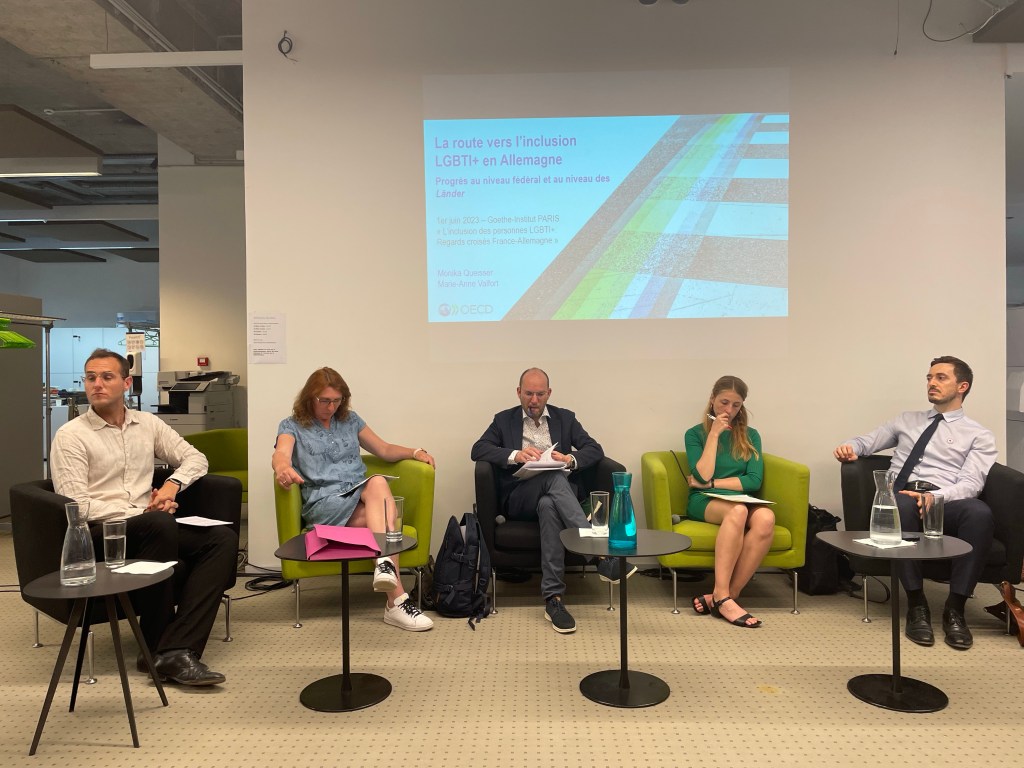
At a recent event at the Goethe-Institut in Paris, my team presented their report on LGBTI+ inclusion in Germany (2020) – and we were fortunate to hear from a panel of leaders in the LGBTI+ community how they compare the German findings to their situation in France.
Long story short: Public policy makes you both laugh and cry, but it’s never dry.
38 and more
And to end on a happier note, I can confirm that the OECD is an incredibly international place. You’ll meet staff from both the 38 OECD member countries and non-member countries. You are constantly surrounded by at least French, English, plus one other language. All speaking at the same time. People “go on missions” (or as non-OECD people would say: business travel) to other countries and bring back exciting sweets. Unfortunately no German chocolate yet.
Completely unrelated update on the bakery hunt: While I still miss my Butterbreze, I will happily replace it with this pistache chocolat pâté for this week:

*Sign up for that French lesson either way. “Je ne parle pas francais” doesn’t get you anywhere here in France. I tried.
 Valeria Silva Gomez, 2023
Comments